Pattern matching and recursion
Lean and its type theory — chapter 3
We know the recursor already, here are more details.
Pattern matching
Recall: for an inductive type α, a function α → β is defined with the recursor α.rec. Pattern matching is a more convenient way to write it: one branch per constructor, each prefixed by |.
def factorial : ℕ → ℕ
  | 0     => 1
  | n + 1 => (n + 1) * factorial n
Lean checks automatically:
-
exhaustiveness: every constructor is covered,
-
termination:
factorial nis on a smaller argument.
Matching on your own types
def MyNat.double : MyNat → MyNat
| .zero => .zero
| .succ n => .succ (.succ (MyNat.double n))
def MyNat.toNat : MyNat → ℕ
| .zero => 0
| .succ n => MyNat.toNat n + 1
#eval (MyNat.double (.succ .zero)).toNat -- 2
m.toNat means MyNat.toNat m.
Pattern matching is translated into the recursor for the kernel, and into running code for #eval.
Lists
inductive List (α : Type u) where
  | nil : List α                    -- written []
  | cons (a : α) (l : List α) :
      List α                        -- written a :: l
#eval (1 :: 2 :: 3 :: [] : List ℕ) -- [1, 2, 3]
A list is empty, or a first element followed by a list. [1, 2, 3] is notation for 1 :: 2 :: 3 :: [].
Notation for lists
infixr:67 " :: " => List.cons       -- Lean's core library

syntax "[" term,* "]" : term        -- simplified
macro_rules
  | `([])          => `(List.nil)
  | `([$a])        => `(List.cons $a List.nil)
  | `([$a, $as,*]) => `(List.cons $a [$as,*])
infixr makes :: a right-associative infix operator with binding power 67, so 1 :: 2 :: [] is 1 :: (2 :: []). syntax declares the bracket form, macro_rules rewrites it, one element at a time, into List.cons and List.nil (more in chapter 1.7).
Functions on lists
One branch per constructor; the pattern _ matches anything. match does the same inside a term.
def length' {α : Type*} : List α → ℕ
  | []      => 0
  | _ :: xs => 1 + length' xs

def isEmpty' {α : Type*} (l : List α) : Bool :=
  match l with
  | []     => true
  | _ :: _ => false
Structural recursion
A recursive call is structural if its argument is a part of the input: an argument of the constructor that built it.
def fib : ℕ → ℕ
  | 0 => 0
  | 1 => 1
  | n + 2 => fib n + fib (n + 1)

example : fib 3 = 2 := rfl
-
n + 2issucc (succ n); its parts aresucc n = n + 1andn. Both calls are structural. -
fibcomputes by ι:fib 3 ⟶ fib 1 + fib 2 ⟶ 1 + (fib 0 + fib 1) ⟶ 1 + (0 + 1). -
def loop (n : ℕ) : ℕ := loop n + 1is rejected. It would giveloop 0 = loop 0 + 1; subtractloop 0:0 = 1.
Two values back
fib (n + 2) needs two earlier values; Nat.rec hands over only one. By hand: carry the pair (fib n, fib (n + 1)).
α × β: the structure of pairs (a, b), with fields p.1 : α and p.2 : β (chapter 1.4).
def fibPair (n : ℕ) : ℕ × ℕ :=
  Nat.rec (0, 1) (fun _ p => (p.2, p.1 + p.2)) n

example : fibPair 10 = (55, 89) := rfl
Lean's own translation of fib carries the values at all smaller arguments (later in this deck).
How a recursor is built
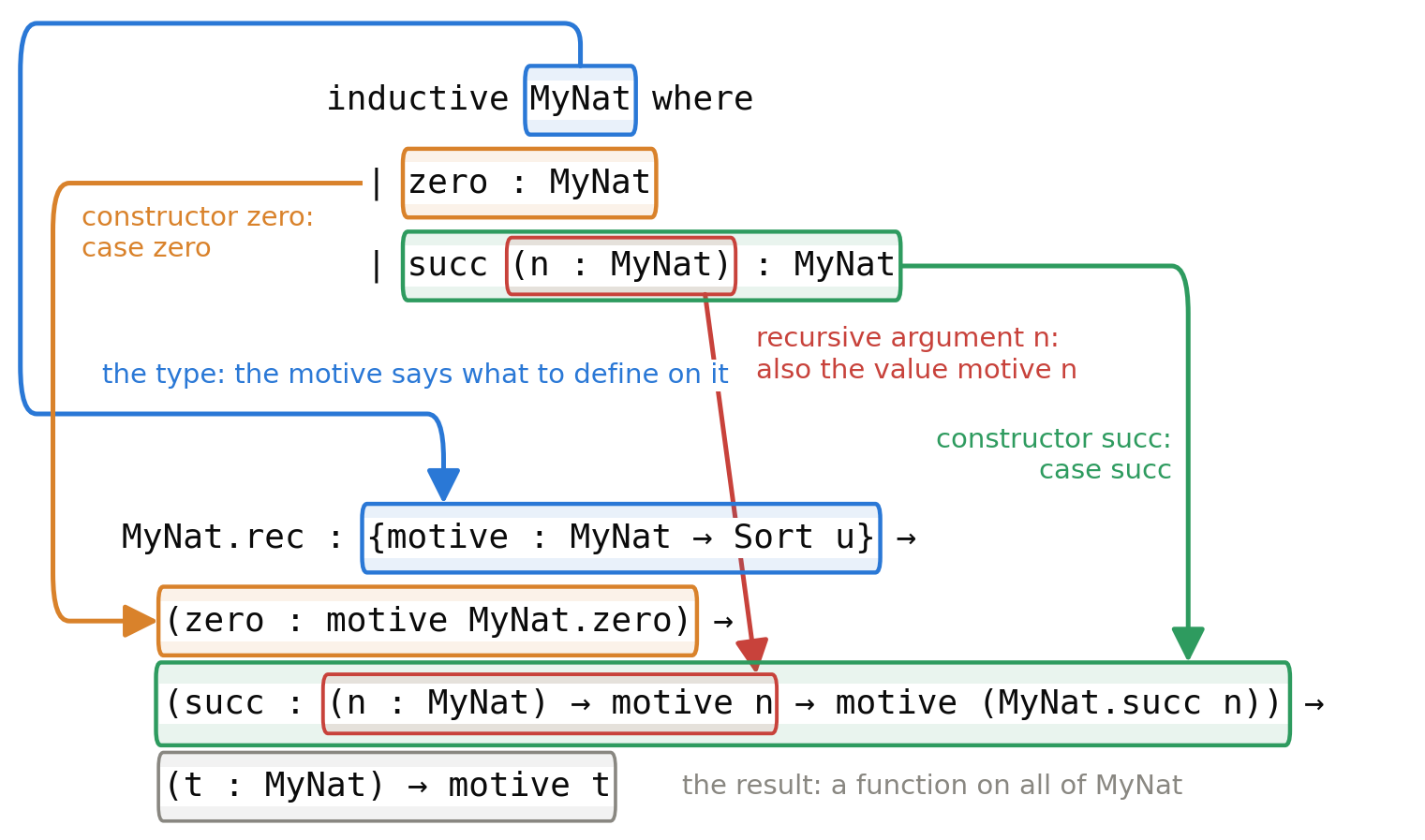
#check @MyNat.rec omits the case names zero, succ.
The recursor in general
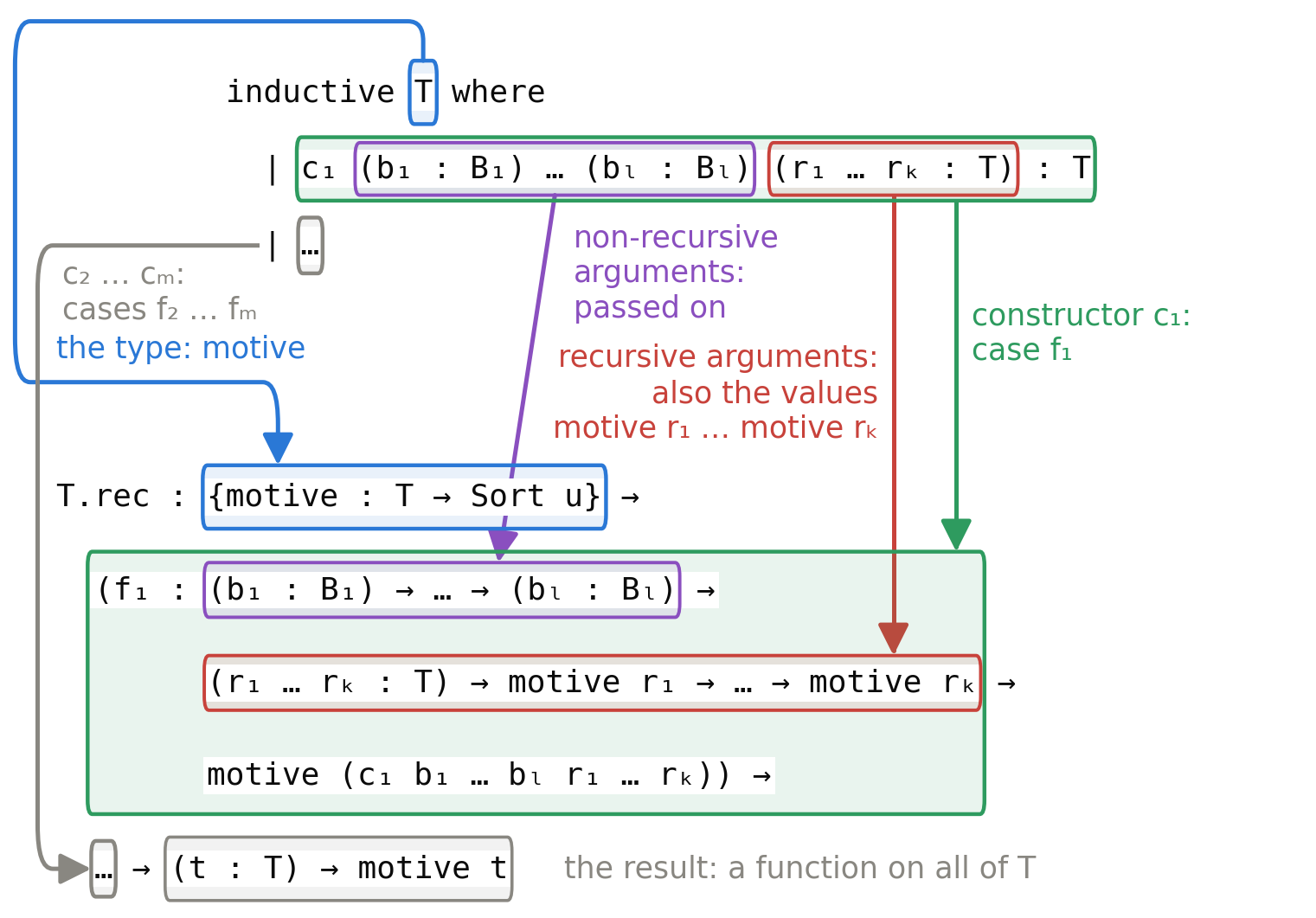
T.rec has no body; the kernel knows it only by its ι-rules. With R := T.rec f₁ … fₘ:
R (c₁ b₁ … bₗ r₁ … rₖ) ⟶ f₁ b₁ … bₗ r₁ … rₖ (R r₁) … (R rₖ)
Example: List.rec
List.rec : {motive : List α → Sort u} →
  motive [] →                       -- case nil
  ((head : α) → (tail : List α) →
     motive tail →                  -- recursive argument
     motive (head :: tail)) →       -- case cons
  (t : List α) → motive t
-
nilhas no arguments;conshashead : αand the recursive argumenttail : List α, so its case getsmotive tail. -
Computation:
List.rec n c (a :: l) ⟶ c a l (List.rec n c l)
Read as a proof, motive tail is the induction hypothesis.
Case splits: casesOn
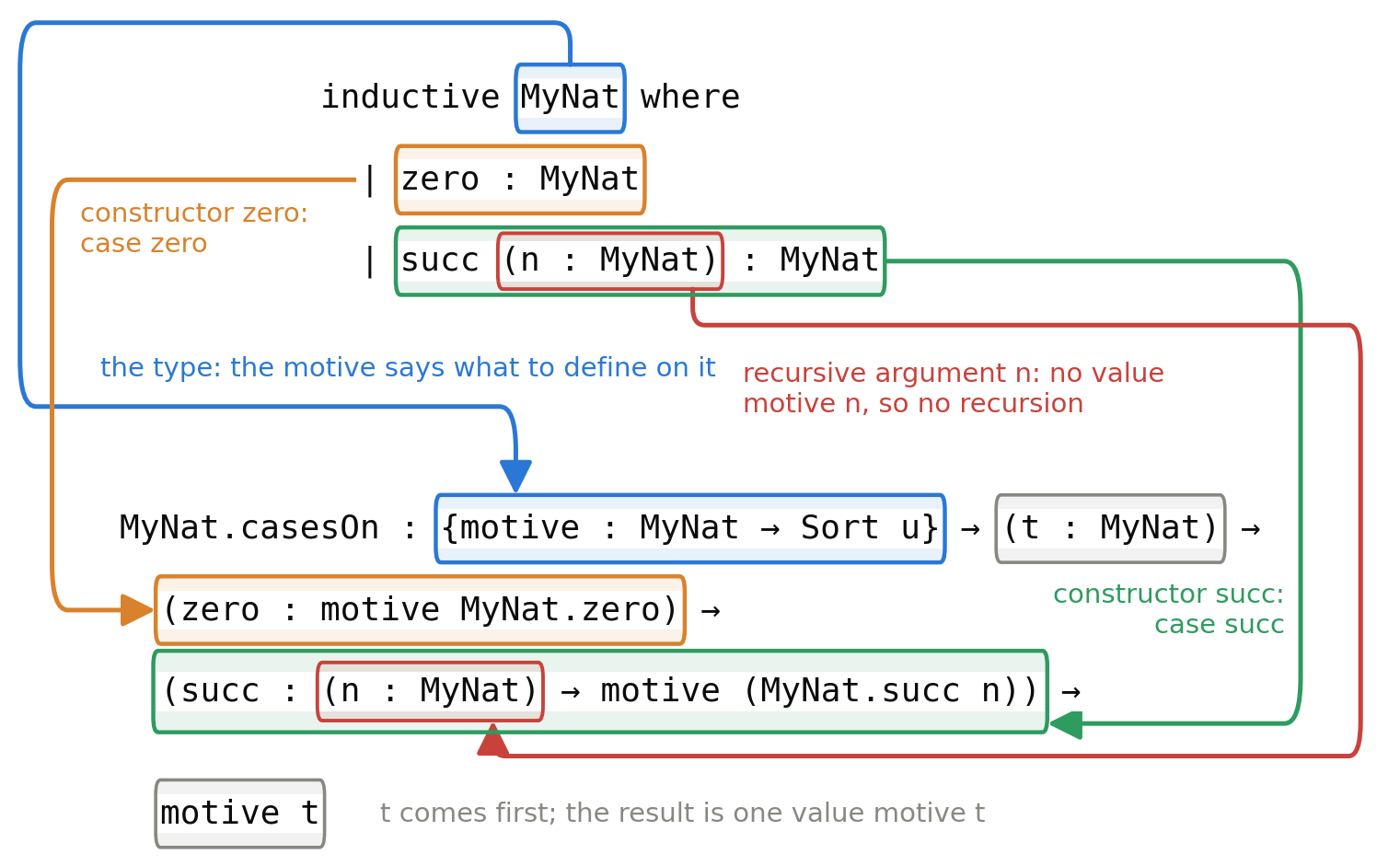
casesOn t z s only asks which constructor built t. It is MyNat.rec z (fun n _ => s n) t; for ℕ: Nat.casesOn.
Are all cases covered?
Lean first writes the patterns of fib with constructors: 0 is zero, 1 is succ zero, n + 2 is succ (succ n). Then it splits from the outside in:
fun x => Nat.casesOn x  (case 0)          -- x = zero
  (fun m => Nat.casesOn m  (case 1)       -- x = succ m, m = zero
    (fun n => (case n + 2)))              -- x = succ (succ n)
So 1 is read in two steps: the outer split finds succ, the inner one finds zero. #print fib.match_1 shows exactly this term.
Every leaf must be reached by a pattern. Without the line for 1: "Missing cases: (Nat.succ Nat.zero)".
Binary trees
inductive BinTree where
  | leaf : BinTree
  | node (l : BinTree) (a : ℕ) (r : BinTree) : BinTree
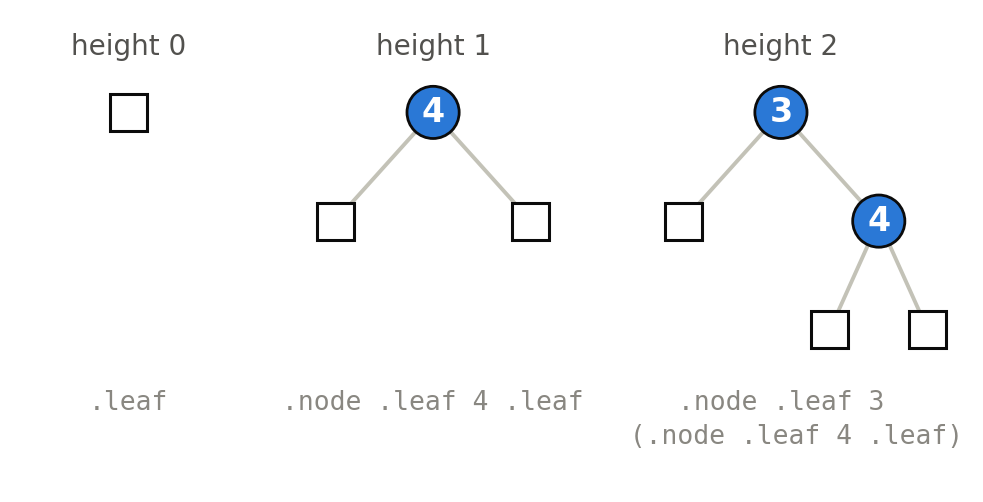
-
BinTreeis the type of all finite binary trees; each element is one tree. -
leaf: a single leaf, no number.node l a r: roota, subtreesl,r. -
All leaves are the same term
.leaf; only their positions differ.
Height: recursion on both subtrees
def BinTree.height : BinTree → ℕ
  | .leaf => 0
  | .node l _ r => max l.height r.height + 1

example : BinTree.leaf.height = 0 := rfl
example : (BinTree.node .leaf 4 .leaf).height = 1 := rfl
example : (BinTree.node .leaf 3
    (.node .leaf 4 .leaf)).height = 2 := rfl
l and r are parts of .node l _ r: both calls are structural.
Termination by a measure
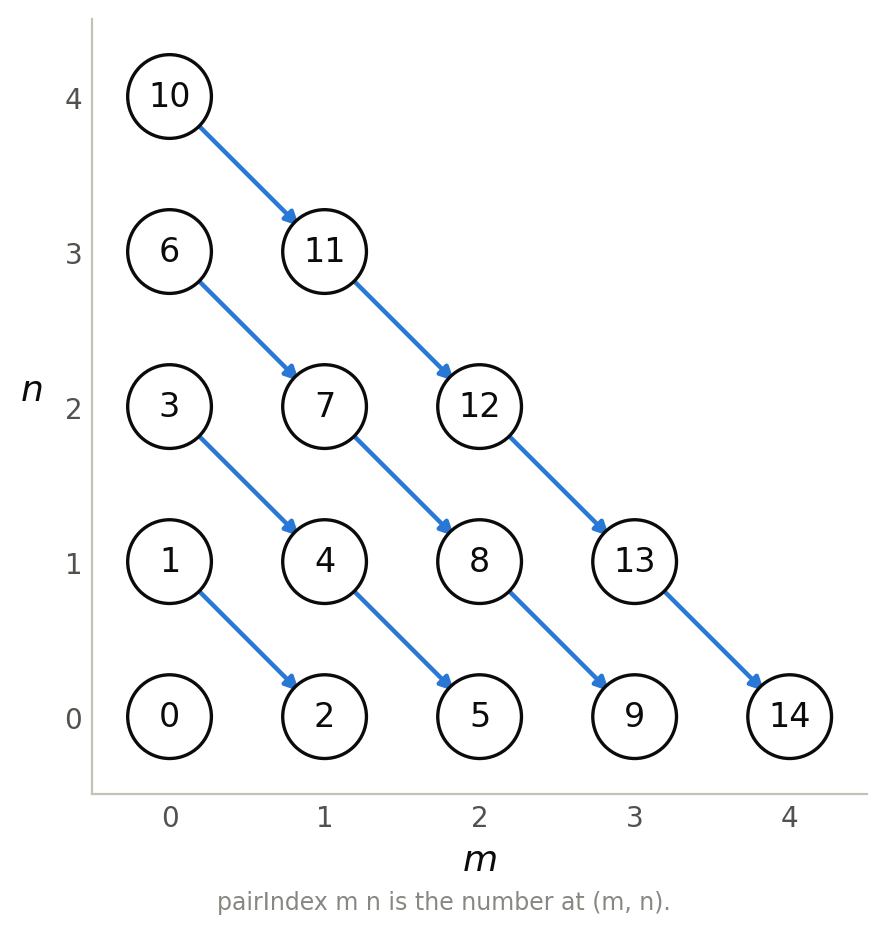
Cantor's enumeration of ℕ × ℕ: pairIndex m n is the position of (m, n).
No argument shrinks in both calls. The pair (m + n, m), diagonal and position, does.
Pairs are compared lexicographically: (a, b) < (c, d) iff a < c, or a = c and b < d.
def pairIndex : ℕ → ℕ → ℕ
| 0, 0 => 0
| 0, n + 1 => pairIndex n 0 + 1
| m + 1, n => pairIndex m (n + 1) + 1
termination_by m n => (m + n, m)
decreasing_by all_goals (rw [Prod.lex_def]; omega)
Lean finds the measure
def logb (b n : ℕ) : ℕ :=
if h : 2 ≤ b ∧ b ≤ n then 1 + logb b (n / b)
else 0
termination_by?
decreasing_by exact Nat.div_lt_self (by omega) h.1
termination_by? prints the measure Lean found: n. On ℕ the order is <. Lean cannot prove n / b < n by itself; decreasing_by gives the proof.
Proving things about recursive definitions
def log2 (n : Nat) : Nat :=
if 2 ≤ n then 1 + log2 (n / 2) else 0
example (n : ℕ) : fib (n + 2) = fib n + fib (n + 1) :=
rfl
example : log2 16 = 4 := by simp [log2]
Structural recursion computes, so rfl works. Well-founded recursion does not: use the equation lemma log2.eq_1, via rw [log2], unfold log2 or simp [log2].
Course-of-values recursion
fib (n + 2) needs fib (n + 1) and fib n, the recursor hands over only one value. Lean's translation passes a table of all smaller values (Nat.brecOn; #print fib shows it). Carrying the pair by hand, as in fibPair, also makes #eval fast:
#eval fib 30                 -- 0.6 s
#eval fib 32                 -- 1.7 s: about 7 million calls
#eval (fibPair 32).1         -- immediate: 32 steps
#eval (fibPair 10000).1      -- immediate, 2090 digits
#eval runs fib as written: every call makes two more, so the time grows like fib n itself, by a factor of about 1.6 per step.
Two steps back in proofs
The same works with a Prop-valued motive: a proof may use the statement for all smaller arguments, here two steps back.
theorem fib_pos : (n : ℕ) → 0 < fib (n + 1)
| 0 => by decide
| 1 => by decide
| n + 2 => by
have h := fib_pos n -- two steps back
show 0 < fib (n + 1) + fib (n + 2)
omega
An infinitely branching tree
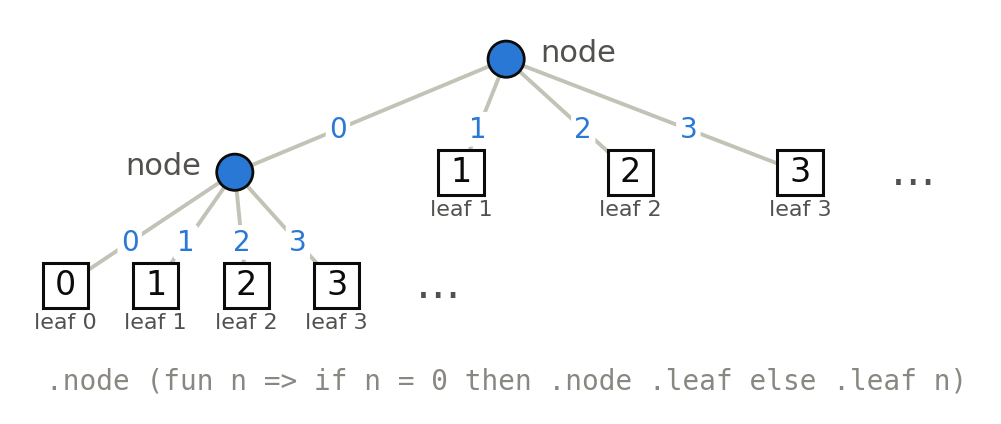
MyTree is a type; its elements are trees. Every path ends in a leaf.
inductive MyTree where
  | leaf (a : ℕ) : MyTree
  | node (f : ℕ → MyTree) : MyTree
-
leaf a: the tree that is a single leaf, carrying the numbera. -
node f: the tree whose root has the subtreesf 0,f 1,f 2, … -
In the type
ℕ → MyTreeoff,MyTreestands right of→. Accepted.
A negative occurrence
inductive Bad where
  | mk (f : Bad → False) : Bad
-- error: (kernel) arg #1 of 'Bad.mk' has a non positive
--        occurrence of the datatypes being declared
Strict positivity: in argument types of constructors, the type occurs only right of →. In the type Bad → False of f, Bad stands left of →.
If Lean accepted it, we would have mk and, by pattern matching | .mk f => f, its inverse unmk. Then:
example (Bad : Type) (mk : (Bad → False) → Bad)
(unmk : Bad → (Bad → False)) : False := by
have neg : Bad → False := fun b => unmk b b
have b : Bad := mk neg
exact neg b
Why positivity is enough
Read in sets, the declared type X satisfies X = F(X):
declaration | equation |
|---|---|
|
|
|
|
|
|
-
Xonly right of→:Fis monotone. The stages∅ ⊆ F(∅) ⊆ F(F(∅)) ⊆ …, continued transfinitely, reach a fixed point: a set that is the type. -
X → ∅has one element ifX = ∅, none otherwise: no solution,Bad ↔ ¬Bad. -
With
X → Boolinstead:Xwould contain its power set. Cantor.
Proved for inductive types: Aczel 1977, Dybjer 1991; for the CIC: Werner 1997; for Lean, checked in Lean: Con-Leche (Breitner).
Summary
-
Pattern matching: one branch per constructor; Lean checks that every case is covered.
-
Recursion must terminate. Structural recursion calls itself on parts of the argument and becomes the recursor.
-
Well-founded recursion needs a measure that decreases; it is used through its equation lemmas, not
rfl. -
The recursor of a type has one case per constructor, with a value of the motive for every recursive argument.
-
Pattern matching becomes
casesOn; structural recursion passes the values at all smaller arguments (brecOn, Project 7). -
Constructors must be strictly positive.